
Breaking News
Supreme Court rules House Republican can challenge mail ballot deadline

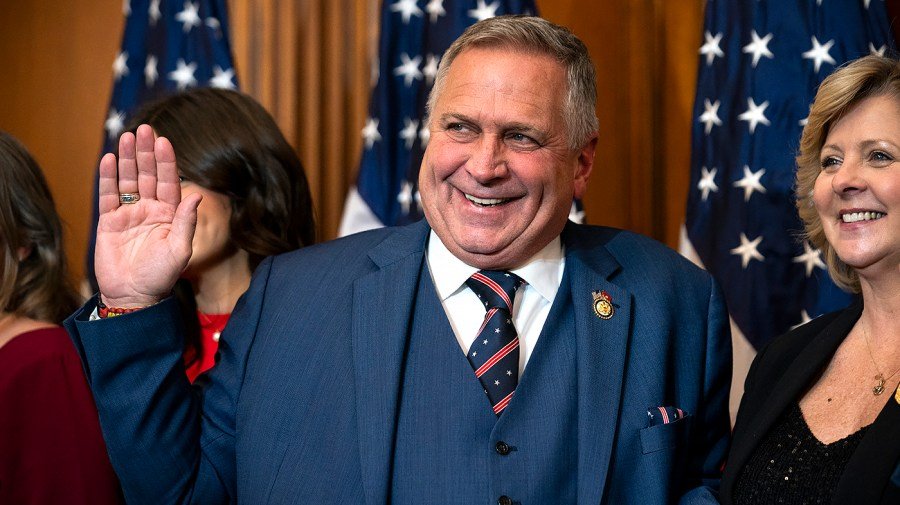
The Supreme Court on Wednesday revived an Illinois Congress member’s lawsuit over a state mail-in ballot law, paving the way for political candidates nationwide to challenge election laws more easily in their states.
The justices ruled 7-2 that Rep. Mike Bost (R-Ill.) has the legal right to sue Illinois over its ability to count mail-in ballots received after Election Day, a practice targeted by President Trump and his allies.
Chief Justice John Roberts wrote the majority opinion over the dissents of two of the court’s liberals: Justices Sonia Sotomayor and Ketanji Brown Jackson.
“Candidates, in short, are not ‘mere bystanders’ in their own elections,” Roberts wrote. “They have an obvious personal stake in how the result is determined and regarded.”
The legality of the Illinois mail-in ballot practice was not before the justices. But lower courts ruled Bost did not have standing to bring the case after finding the votes likely would not much impact his own race.
Roberts said unlawful election rules can injure candidates in several ways, from lost elections and spent resources to decreased vote shares and damaged reputations. But candidates also have an interest in fair processes, he said.
“Win or lose, candidates suffer when the process departs from the law,” the chief justice wrote. “Thus, the long-shot and shoo-in alike would suffer harm if a State chose to conduct its election by, say, flipping a coin.”
When unlawful votes are counted or lawful ones are discarded, public confidence in elections erodes, Roberts continued. From there, diminished confidence in the elected representative follows, which amounts to a concrete harm, he said.
By letting Bost’s suit move forward, the high court may be opening the floodgates for candidates across the country — and political spectrum — to fight election rules in the courts.
Illinois argued “chaos” could ensue for election officials if the justices sided with Bost. More than a dozen states, plus the District of Columbia, let mail-in ballots be received after Election Day so long as they were postmarked or certified by the time polls close.
Jackson called the decision a “dubious departure from settled law” in a dissenting opinion joined by Sotomayor. She noted that standing requires a “personal stake” in the alleged dispute and suggested the majority agreed to do away with that requirement for political candidates.
“[The court] declares that all candidates have standing to challenge election regulations in light of their interest in a ‘fair process,’” Jackson wrote. “No matter that, in a democratic society like ours, the interest in a fair electoral process is common to all members of the voting public. The Court thus ignores a core constitutional requirement while unnecessarily thrusting the Judiciary into the political arena.”
She contended that setting the usual standing requirements aside “opens the floodgates” to “troubling election-related litigation.”
Roberts rebuffed the notion that the court’s ruling would pave the way for trivial lawsuits, suggesting it is “neither clear why candidates would waste their resources in this way nor on what basis in federal law such suits could be brought.”
To avoid that outcome, nonetheless, he wrote in a footnote that the court’s decision only addresses candidates’ standing to challenge rules that govern the counting of votes in their elections.
Bost had argued that the aftermath of the 2020 presidential election caused courts to clamp down on candidates’ ability to challenge rules governing their campaigns. The 2020 election was rife with misinformation, as Trump pushed false claims of election fraud after losing to former President Biden.
Justices Amy Coney Barrett, a conservative, and Elena Kagan, a liberal, wrote in a concurring opinion that they agreed with the court’s judgment but not its reasoning.
Bost’s standing stems from a “traditional pocketbook injury” he has faced, and would continue to face, from the costs of paying poll watchers to monitor ballot-counting after the election and ensure votes with discrepancies aren’t tallied — not his status as a candidate, they said.
The Trump administration took Bost’s side. Trump signed an executive order in March seeking to require all votes to be “cast and received” by Election Day, but it has been challenged in court.
Two of Trump’s 2020 presidential electors for Illinois — Laura Pollastrini and Susan Sweeney — sued the state alongside Bost in May 2022. The trio is represented by the conservative legal group Judicial Watch.
The high court wrote in a footnote that, since only one plaintiff needs standing for a suit to proceed, the justices did not decide whether Pollastrini and Sweeney have the legal right to sue as prospective electors.
Bost was elected to the U.S. House in 2014 to represent Southern Illinois and chairs the House Veterans’ Affairs Committee. He said in a statement after the ruling that the “initial battle” was won but the “fight for election integrity continues.”
The Republican National Committee called the decision a “major win” for election integrity and “basic accountability.”
“Federal law is clear: Election Day should be the deadline for ballots to be received, which is why the RNC filed an amicus brief supporting Congressman Bost’s challenge to Illinois’ ridiculous practice of counting ballots received up to two weeks after an election,” said RNC chairman Joe Gruters. “Today, the Court confirmed candidates can challenge unlawful election procedures in their own races – a key step toward ending this unlawful scheme.”
Updated at 4:27 p.m.
Copyright 2026 Nexstar Media, Inc. All rights reserved. This material may not be published, broadcast, rewritten, or redistributed.
For the latest news, weather, sports, and streaming video, head to The Hill.