The Supreme Court won’t consider the fate of President Trump’s blanket tariffs until November, but the White House already appears to be making adjustments that could keep as many duties as possible in place if the administration loses.
It’s a refocusing of sorts on the tariff authority derived from Section 232 of the Trade Expansion Act of 1962, which allows the president to target sectors of the economy based on national security considerations, in a series of moves already leading to another bout of uncertainty in the business world.
Those powers are more legally established than presidential authority under the International Emergency Economic Powers Act of 1977 (IEEPA), a separate law Trump used to impose his “Liberation Day” tariffs six months ago. His use of IEEPA is at the heart of the case now before the Supreme Court.
Trump’s pivot to Section 232 can be found on his Truth Social feed, which has been marked by a slew of sector-specific tariff promises on industries ranging from pharmaceuticals to semi-trucks to furniture.
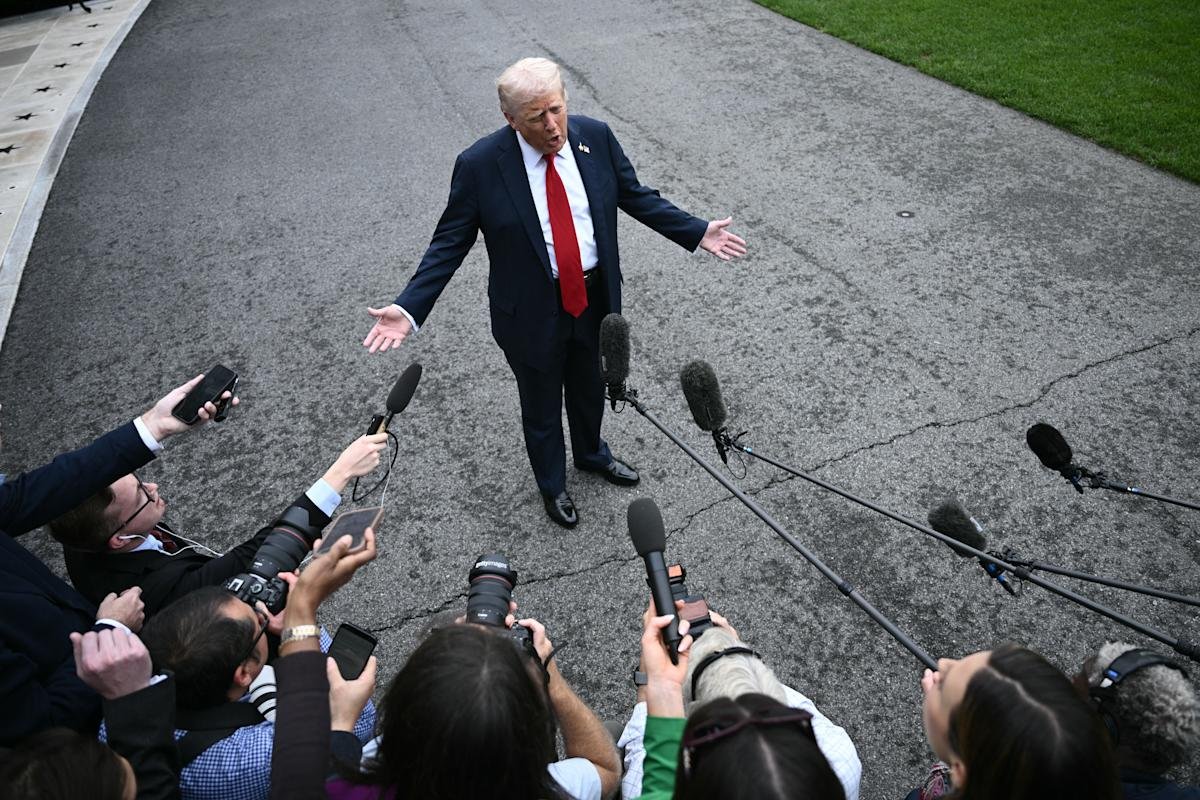
President Donald Trump speaks to reporters at the White House on September 30. (BRENDAN SMIALOWSKI/AFP via Getty Images) ·BRENDAN SMIALOWSKI via Getty Images
More sectors are likely close behind, with long-promised semiconductor tariffs the biggest shoe yet to drop. And of course, trade talks with China are set to heat up before a meeting between Trump and Chinese President Xi at the end of this month.
The early lessons so far? Sectors could be in for plenty of whiplash.
“The challenge with tariffs is they create a ton of uncertainty,” notes Natasha Sarin, the co-founder of the Budget Lab at Yale.
“That isn’t uncertainty that is likely to be resolved by the court,” she added. “Even a ruling against the administration means you’ll likely see them turn to other trade authorities down the road.
Read more: What Trump’s tariffs mean for the economy and your wallet
As for the question of when uncertainty may fade, “it’s probably going to be a while,” Stifel Chief Washington policy strategist Brian Gardner told Yahoo Finance this past week.
Gardner’s expected timeline is lengthy, given that Trump is in the process of building out his plan B. But “we don’t know exactly what plan B is yet” as well as Trump’s likelihood of using tariffs as a tool of foreign policy for his entire term.
Up first is the new Supreme Court term, which begins by law on the first Monday in October. The justices will hear tariff arguments on Nov. 5 and have signaled that a decision could be in hand before the end of the year.
That ruling could either uphold these IEEPA powers or invalidate the duties and perhaps even mandate the administration to offer refunds.
Story continues
President Donald Trump’s “Liberation Day” tariffs were first unveiled in April and based in legal authority that the Supreme Court is now reviewing. (BRENDAN SMIALOWSKI/AFP via Getty Images) ·BRENDAN SMIALOWSKI via Getty Images
That’s why Trump and his team have been hard at work building out this insurance policy of sorts around 232 tariffs, which have been used for years by presidents in both parties and are seen as relatively secure from legal challenges.
Trump had already used the 232 authority this term to impose tariffs on things like steel, aluminum, and copper.
More tariffs under that authority have been promised in recent weeks, ranging from 25% to 100% on goods from pharmaceuticals to semi-trucks to kitchen cabinets and furniture. Some are already in place, and others are coming later this month.
The Trump administration also broke with some government shutdown precedents by declaring this past week that ongoing tariff investigations are essential government functions and could continue.
The effect there is to keep the wheels turning on active Section 232 investigations, which would then keep the future implementation of duties on goods from critical minerals to semiconductors on track.
Areas ranging from robotics to medical devices to personal protective gear could follow after the administration recently opened new investigations in these areas.
Meanwhile, a lesson from this past week around pharmaceuticals suggests that the effect of these sector-specific tariffs may be harder to predict.
At the very least, they will be subject to a lot more back-and-forth with Trump and his team.
As recently as this summer, the president was promising what sounded like broad-based pharmaceutical tariffs, including that companies “are going to be tariffed if they have to bring the pharmaceuticals into the country at a very high rate, like 200%.”
That rate then fell to 100%, and more importantly, exception after exception was offered.
First, it was that any pharmaceutical company “building” in the United States would be exempt from tariffs. Then, exemptions were extended to any drugs imported from a nation where a trade deal has been struck.
President Donald Trump and Secretary of Commerce Howard Lutnick, far left, are seen in the Oval Office this week for the announcement of a deal with Pfizer to lower Medicaid drug prices. (Win McNamee/Getty Images) ·Win McNamee via Getty Images
Then early this past week, the president announced Pfizer (PFE) is in line for a three-year exemption from tariffs as part of a deal in which the company agreed to slash some of its drug prices.
At the event with Pfizer, Commerce Secretary Howard Lutnick suggested that those drug price talks mean exceptions for other companies.
“While we are negotiating with these companies, we’re going to let [the talks] play out,” Lutnick said, adding that tariff enforcement for now is “standing by.”
It means these tariffs are fully on hold while the administration launches new talks with the industry on bringing their plants to the US, as well as their prices.
It has clearly set up an unpredictable situation for drug companies that could stretch for months or even years and be a template for other sector tariff rollouts to come.
But it might not be all bad for investors and business leaders. After all, this week’s turmoil saw pharmaceutical stocks have their best week in 16 years.
Ben Werschkul is a Washington correspondent for Yahoo Finance.
Click here for political news related to business and money policies that will shape tomorrow’s stock prices
Read the latest financial and business news from Yahoo Finance